
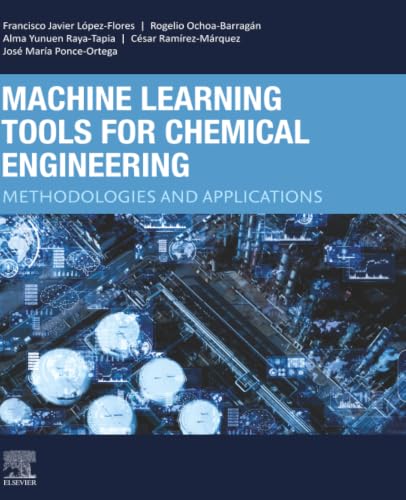
Machine learning tools for chemical engineering : methodologies and applications / Francisco Javier López-Flores...[et al.]
Language: English Publication details: Elsevier, 2025. Amsterdam :Description: xi, 616pISBN:- 9780443290589
- Machine learning -- Applications
- Chemical engineering
- Artificial intelligence -- Methods
- Predictive models (Computer science)
- Chemical engineering
- Artificial intelligence
- Physics-informed machine learning
- Surrogate modeling in chemical processes
- Soft sensors
- High-throughput screening
- Digital twins in chemical engineering
- Chemical process control
- Chemical processes
- Materials informatics or Chemoinformatics
- Chemical reactions
- Neural networks (Computer science)
- 660.0285 T25 LOP
| Item type | Current library | Call number | Status | Date due | Barcode | |
|---|---|---|---|---|---|---|
 Books
Books
|
Nalanda Library | 660.0285 T25 LOP (Browse shelf(Opens below)) | Checked out | 07/09/2026 | 22800 |
Product content
Content includes any type of illustrations.
The primary content is text.
Content includes a significant number of actionable (clickable) web links to external content, downloadable resources, supplementary material, etc.
Content includes a significant number of actionable (clickable) cross-references, hyperlinked notes and annotations, or with other actionable links between largely textual elements (e.g., quiz/test questions, 'choose your own ending', etc.).
Content includes photographs, whether in a plate section / insert or not.
Content includes figures, diagrams, charts and/or graphs, including other 'mechanical' (i.e. non-photographic) illustrations.
Content includes a significant number of web links (printed URLs, QR codes etc.).
Content includes mathematical notations, formulae.
Machine Learning Tools for Chemical Engineering: Methodologies and Applications examines how machine learning (ML) techniques are applied in the field, offering precise, fast, and flexible solutions to address specific challenges.
ML techniques and methodologies offer significant advantages (such as accuracy, speed of execution, and flexibility) over traditional modeling and optimization techniques. This book integrates ML techniques to solve problems inherent to chemical engineering, providing practical tools and a theoretical framework combining knowledge modeling, representation, and management, tailored to the chemical engineering field. It provides a precedent for applied Al, but one that goes beyond purely data-centric ML. It is firmly grounded in the philosophies of knowledge modeling, knowledge representation, search and inference, and knowledge extraction and management.
Aimed at graduate students, researchers, educators, and industry professionals, this book is an essential resource for those seeking to implement ML in chemical processes, aiming to foster optimization and innovation in the sector.
Key features
Outlines the current and potential future contribution of machine learning, the use of data science, and, ultimately, how to correctly use machine learning tools specifically in chemical engineering
• Devoted to the correct application and interpretation of the results in various phases of the development of decision support systems: data collection, model development, training, and testing, as well as application in chemical engineering
• Examines chemical engineering-specific challenges and problems, including noise, manufacturing equipment, and domain-specific solutions, such as physical knowledge using relevant case study examples
There are no comments on this title.