
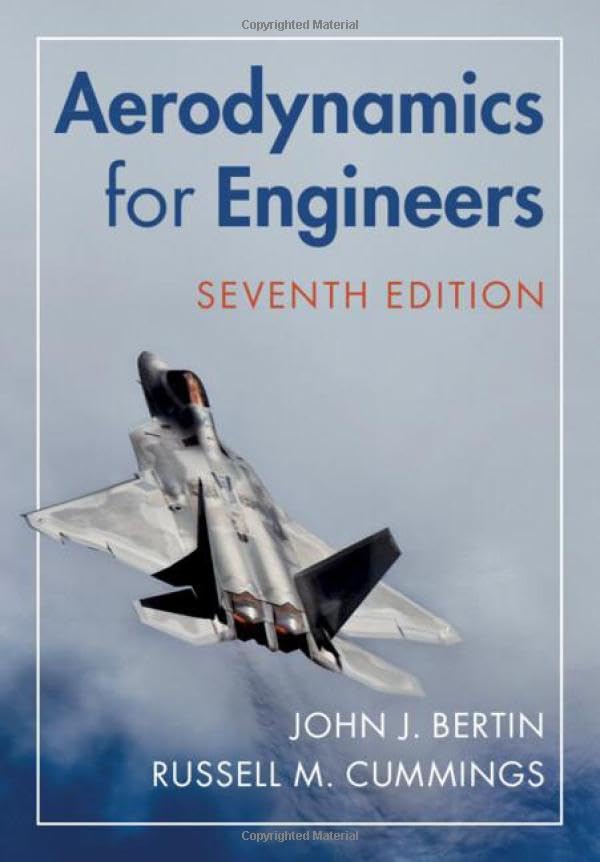
Aerodynamics for engineers / John J. Bertin and Russell M. Cummings
Material type: TextLanguage: English Publication details: UK : Canbridge University Press, 2025. Description: xiii, 943pISBN:
 - 9781009501309
- 629.1323 T25 BER C
| Item type | Current library | Call number | Status | Barcode | |
|---|---|---|---|---|---|
 Books
Books
|
Nalanda Library Circulation Books | 629.1323 T25 BER C (Browse shelf(Opens below)) | Available | 23139 |
Browsing Nalanda Library shelves, Shelving location: Circulation Books Close shelf browser (Hides shelf browser)
| No cover image available No cover image available |

|

|

|
No cover image available No cover image available |

|

|
||
| 629.1323 T17 HOU.C Aerodynamics for engineering students | 629.1323 T18 AND Fundamentals of aerodynamics | 629.1323 T24 DIM Unsteady aerodynamics : potential and vortex methods / | 629.1323 T25 BER C Aerodynamics for engineers / | 629.13230011 T09 RAO J Flight mechanics modeling and analysis | 629.132323 N90 BRO Theory, tables and data for compressible flow | 629.132323 T03 AND Modern compressible flow : with historical perspective |
Revised and expanded to reflect cutting-edge innovation in aerodynamics, and packed with new features to support learning, the seventh edition of this classic textbook introduces the fundamentals of aerodynamics using clear explanations and real-world examples. Structured around clear learning objectives, this is the ideal textbook for undergraduate students in aerospace engineering, and for graduate students and professional engineers seeking a readable and accessible reference. Over 10 new Aerodynamics Computation boxes that bring students up to speed on modern computational approaches for performing aerodynamic analysis, including various Matlab® programs, OpenVSP, XFOIL, CBAero, Kestrel, and other analysis tools. New end-of-chapter team projects show students how to work together to solve larger, more important aerodynamic problems, in many cases using the computational approaches listed above. New and expanded coverage of propellers, UAVs, transonic wings, wingtip devices, drones, hypersonic aircraft, and aircraft design. New pedagogical features including Look Ahead navigation, expanded use of SI units in new homework problems, and many new Aerodynamics Concepts boxes featuring advanced experimental aircraft concepts. Additional references in each chapter that bring current advancements in aerodynamics into each part of the book.
Key features
• Introduces modern simulation approaches using Open Source software, such as OpenVSP and XFOIL, as well as commercial packages such as Matlab
• Includes new individual or team projects in each chapter, often involving software, fostering hands-on student learning, and group collaboration
• Merges previous US and International editions, allowing instructors to choose the unit system that best suits their needs
• New Aerodynamics Computation boxes, introducing students to how modern computational tools are used for aerodynamic analysis
• Includes additional Aerodynamics Concept boxes, motivating students by showing theoretical concepts applied to modern aircraft projects
• New references in each chapter that present modern aerodynamic concepts
There are no comments on this title.